This note is written by Kim- I have a renewed sense of peace this morning, after reading a word from Isaiah and I was yet again reminded of something Maya said a few weeks back. Here is the story….about a week after Pete left I was folding laundry in our living room. Maya came over to me and asked if she could help me fold the laundry. I had a pile of socks yet to be matched up, so I asked her if she would like to find the matches and fold them. She was very excited!
I figured I needed to make the most of her excitement about helping with laundry. If you start them young they like to do it all through growing up years…right?! She was doing a great job and I was giving her words of encouragement, “You are doing very well with finding the matches and folding the socks together, Maya!” She very proudly looked up at me and said, “My daddy taught me how!”
I was speechless for a couple reasons….one, I have been folding the laundry, and secondly, I was immediately struck with how proud she was of her daddy. As I thought more about how she responded, I also could not help but wonder if I am that proud of my heavenly Father and the essential life truths that He teaches me, everyday. Matthew 18:3 says, “I tell you the truth, unless you change and become like little children, you will never enter the kingdom of heaven.”
I felt like I saw a glimpse of what it means to “become like little children”. To be filled with such admiration, love and devotion to the Father! To have such a sense of peace that our Father is alongside us in life! The passage I read in Isaiah this morning was this, “For I am the Lord, your God, who takes hold of your right hand and says to you, Do not fear: I will help you. Do not be afraid, O worm Jacob, O little Israel, for I myself will help you, declares the Lord, your Redeemer, the Holy One of Israel.” Is 41:13-14 (I added the bold)
I really have a sense of peace this morning in the truth that that my Redeemer, my God is helping me and taking hold of my right hand! I am proud to say that He is calming my anxiety about rushing the last weeks of deployment, and the little everyday tasks that build up around me! My Daddy is teaching me this!
~ Kim
February 23, 2011
January 8, 2011
I just got back from R&R. It was a short two-week vacation from the deployment that I spent at home. The past several months has provoked a lot of thought about “home” in the Robinson family. My Soldiers here and their families have thought about home, too. Some have forgotten the sacredness of home, some have missed home but they have all longed for it…at least in my opinion they have. There are two kinds of home I’ve longed for…one is my home in Fort Riley where a beautiful woman, spirited girl and a smiling boy are awaiting my return and the other is in the everlasting arms of God…Chad Bohi in his song, “Jesus Our Relief” describes it like this, “when I’m broken down and weak, it is your grace that covers me, it comforts me. In your everlasting arms it is where I belong, it is where I’ve found my home.”
Another look at home came from an article I read a few weeks ago that interviewed the wife of an Army Chaplain from Fort Carson in Colorado. Her husband was killed by an IED along with several of his Soldiers while he was out “bringing God” to his men. In the interview she said one of the most difficult things she had to do was to tell her young kids about what happened to their daddy…she asked the kids where the best place in the world was…they said “home.” She then asked where their REAL home was and they said “heaven.”
Home is best experienced when our relationship with both “homes” is in the right place. The past several months the Robinson family has worked hard and prayed a lot about those two relationships and though we would all say we are fine never experiencing a deployment again we are still in some way excited about the next several months of deployment that are left…not just because the deployment will be over and I’ll be back home for a while either. We are excited because God has been so involved in our lives in amazing ways throughout it…it doesn’t take a deployment to experience God and grow in your relationship with Him and your family but right now it is all we’ve got. We certainly experienced the love and goodness of God over R&R…since I’ve returned I haven’t stopped talking about how God has been so involved…from how impressive Kim is to how well Maya and Eli are doing. I hope you experience or are experiencing this with your family, too.

the fam...
I can’t wait to go home…both homes.
November 6, 2010
So, Maya stuck some keys in an outlet upstairs not even 2 hours after we (me and the kids) got back from our trip to Ohio. She started crying and came downstairs. I came running as soon as I heard the very distinct cry of something being wrong. When I got to her I noticed that her hands were black. I knew this was not good.
I was doing my 100 point assessment when I thought I should look upstairs and make sure nothing was smoldering! I ran upstairs to find the keys hanging from the outlet. Everything is fine thankfully!
The next day I went to the store and found the outlet covers that one would think, me being a nurse, I would have had covered already! So like a great mom I covered my outlets. That afternoon, Maya brought me an outlet cover and said “what’s this?” Well so much for being extra cautious.
Safety check take two: I put the safety knobs on the kids bedroom door today to prevent Maya from going in there to get to Eli when he is sleeping, or to go in and unload her closet to find the perfect dress about 5 times a day, or to go in and climb the dresser for a little afternoon adventure. While I was putting them on I had a thought: Are these really safe? I mean if there were a fire or something or Maya needed to go the bathroom she wouldn’t be able to get out. Well, not so sure that is a problem for Maya….I had just laid her and Eli down for a nap and about 2 minutes later I hear Maya saying behind her closed door. “I don’t want these here.” Then I heard, what I later found out was a book, hitting the door knob to get it off. Well, that was not successful so Maya, in her “I’m going to do what I came to do spirit”, just tried taking them off.
A few seconds later Maya was walking into my room with an arm load of safety door knobs. She dropped them on the floor and said, “I don’t want these in my room, you can have them in yours, but not in mine!”
Now Maya is laying in bed singing. Right now I just feel like laughing!
~ Kim
September 6, 2010
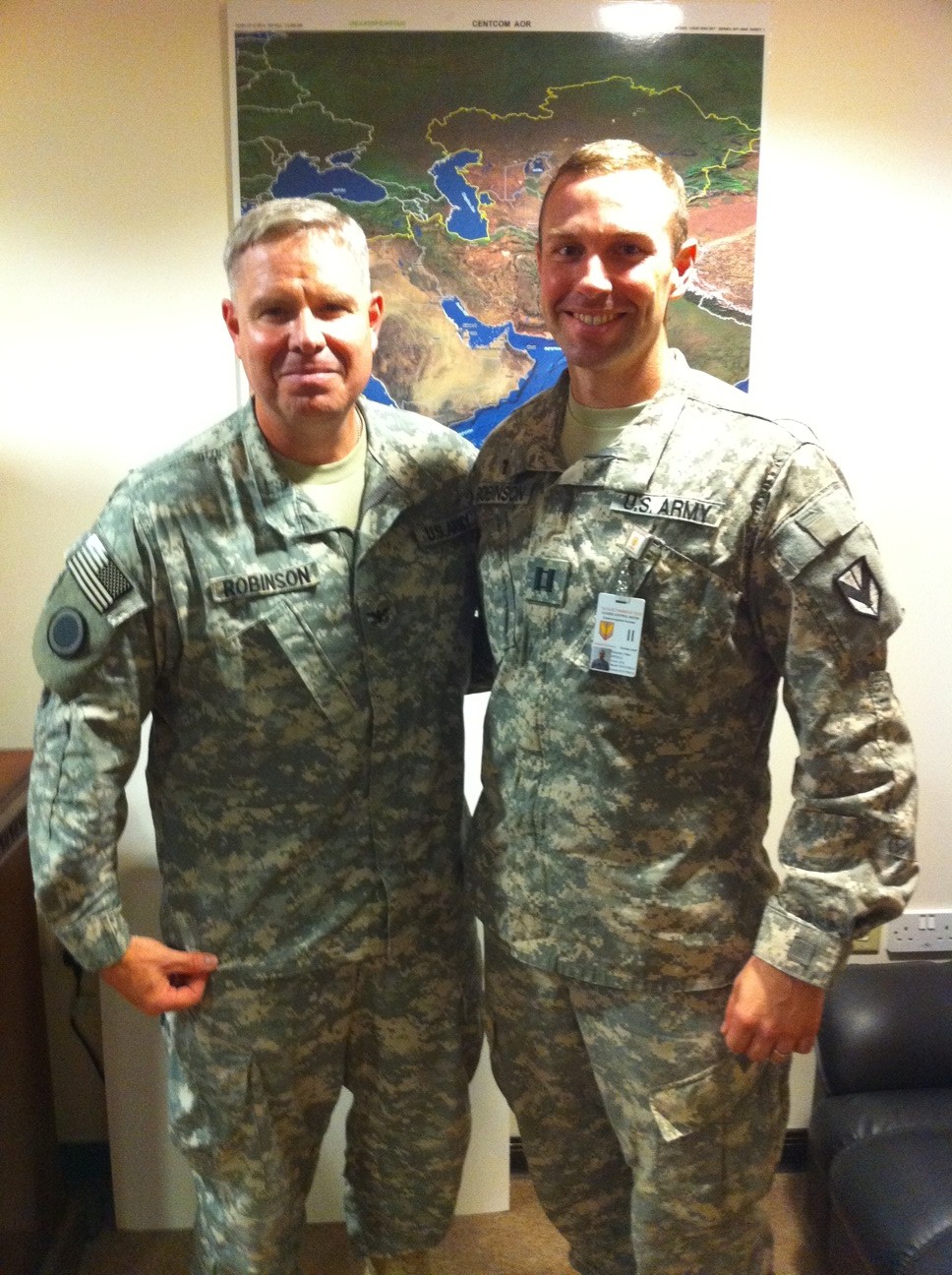
manly picture...
Most of us know what it feels like to be far from home. The feeling of unfamiliarity that surrounds you, lots of new places and going back to your new “area of residence” that feels cold and awkward. For most that story does not last very long…in the Army that story seems never-ending. You try to do things like add pictures of family, drawings from your kids, little nick-knacks and other pieces of decor that remind you of home but in the end they fall short of helping you have that feeling of home.
Once in a while something cool will happen. You will get something from home…a package, a card, cookies, Mom’s pound-cake, more cookies, more of Mom’s pound-cake, still more of Mom’s pound-cake and its a special feeling that helps to serve as some pseudo drug that temporarily makes you feel a little more at home. I remember getting a package from my Mom when we first got out here and I was pumped…then I got a card from Mom…then I got another package from Mom…I confess, by this point in the process I had tears in my eyes and an “I love my Mom” smile.
Recently I got an email from my uncle who is also in the Army. He was traveling through and was going to have about an hour or so to chat. I ended up getting to talk with him for nearly an hour and left feeling refreshed like I had expeienced a little slice of home. It was a big morale booster for me and got me through the rest of the week bragging on how I got to see my uncle. Enjoy your time at home!
manly picture...
May 14, 2010
For the first time in several weeks I was feeling really good. Not just “good” like things are going good and I’m feeling “good.” But good in the sense of the kind of “good” that nothing else really is like. The way you feel only when you are with a very, very small group of select people and sometimes the way you feel when you listen to a certain song or go to a certain place and to me its like those people, those songs and those places are sacred…they feel like home. I feel close to everything “God-related” when I’m “there”, listening to “that song,” spending time with “those people.”
The past weeks but especially the last couple of days I have been a hard charger. I’ve been at the “office” at 4am, which happpened to be the rifle range this morning and I’ve been at the office late 10pm doing staff work and combating my arch-enemy, powerpoint. Not to mention the fact that I am at war and therefore do not have the luxury of days off…I have resiliency time. Bits and pieces of a day where I take off and go get recharged; whether its reading a book about being a better dad or a better leader, doing laundry, talking with Kim and family, writing cards and emails home, working out or going diving in the Persian Gulf I do something that recharges me. Today, I took a nap.
I was out hard, the first time since being here that I haven’t had to lull myself to sleep listening to Bach or Pachivelli. I had just pulled up to the driveway of what must have been my house. It was dark outside and I remember just knowing that the house I was looking at was my house. Garden lights led a pathway from the garage door and garden area over to the front door of the house. I remember looking through the windows that were on the garage doors and seeing Kim’s care inside the garage and then my reflection. I was wearing a white shirt, chaco sandals (the best ever) and some crazy looking board shorts. We must have lived near the beach and I was still young…the grass looked really nice, there were a couple palm trees in the yard and I remember it really feeling like home. The front door was opened and light from inside the house was shining through the glass storm door and I remember thinking, “I can’t wait to see Kim, I really want to see Kim.”
The annoying carribean ring of my cell phone went off and the dream stopped. I…was…ticked and hurt at the same time. I felt like a golf ball was in my throat and as I put my boots back on and walked back to my Soldiers I was glad I was wearing my huge sunglasses since they would hide any tears that were shed. Just as I thought they were about to start flowing a couple Marines driving by in their truck slowed down and asked if I wanted a ride. Shoulders rolled back, chest out and chin placed sharply up I said, “yes.” They told me that God works in mysterious ways…I laughed and said, “he does.”
April 21, 2010
The dreaded day has already come and gone. Ever since I found out that I would be assigned as a batallion chaplain to Fort Riley I knew that I would be deploying and had an idea within a week or so regarding when that day would come. We (the fam and I) took advantage of as many opportunities as we could to spend time together and make good memories leading up to the day of deployment. I ate lunch with the family as much as possible, worked my hardest at work and came home as early as possible, played soccer, went to hundreds of balls at Cinderella’s castle, took Kim out on some hot dates and a lot of family walks combined with trips to the playground.
 Kim and I talked about the day a lot, too. We talked about what things we should expect like how often we will be able to talk/communicate and what modes of communication we would have; we talked about what things we feared and were nervous about regarding the deployment; we talked about how we planned to stay strong in our relationship with God and we talked about how we could make this year apart one of the best years of our lives.
So far our hard work has been paying off. We are still early in the deployment but Kim and I each feel as though we have been growing closer to each other, even though we are far apart. Theologically, we have to believe that the best years of our lives are not the ones behind us or the ones to come but its the one we are living in right now.
December 18, 2009
Wow! It is hard to believe how much time has passed by since my last note and how much has happened. Here is just a quick “drive-by” on what has happened since then:
-Got moved into the house…pictures on the wall and all
-Enrolled Maya into a ballet class which basically gives her some playtime with other kids and some new dance moves for dancing with me 🙂
-Helped my come to the conclusion that The Three Amigos is one of her favorite movies…I frequently am asked “Daddy, can we cuddle on the couch, eat popcorn and watch the amigos?”…yeah, makes me melt, too.
– Planned and pulled-off my first marriage retreat
– Completed several invocations at deployment ceremonies and change of command ceremonies for my Soldiers
– Took a military tactical vehicle driving course, so that I can drive my Humvee while my assistant runs security with his weapon (I’m not allowed to carry a firearm)
– Counseled a lot of Soldiers
– Worn myself out exercising with Soldiers in the mornings
– Gone on a ruck march
– Watched the most amazing woman in the world go from pregnant to not pregnant as she delivered our first boy, Elliot (per Maya he was delivered through Mommy’s belly button)
– Got to spend Thanksgiving with my girls, my boy and my parents
– Got promoted
– saw my chaplain-assistant leave to deploy with another unit and got a new one, today! Seems like he is going to be a great assistant…19 year old guy from Illinois, I’m pumped!
– And, finally…got to spend a day and two nights with a real piece of work who I consider to be on a short-list of best friends
Lots of good stuff has happened.
My unit is now beginning to ramp up in a more intense fashion to prepare for our up-coming deployment and I’m beginning to work with a woman who works for Soldier’s Angels that helps to provide things for Soldiers…and Chaplains 🙂 Please keep the coming deployment in your prayers.
September 26, 2009
We have successfully made our trek from Fort Jackson to Fort Riley. En route I had a quick visit to Reno and got to see some of our good friends, hopefully a return trip will come soon with the Maya and Kim and our soon to be born son so that we can see everyone…including ones that I missed on the last trip. We had a lot of help from friends, Kim’s parents and mine with the move. Friends helped me pack the trailer, Kim’s parents helped us get out here and my parents and grandparents helped us get things moved in, cleaned up, fixed and put in place. One of our favorite pieces of furniture, our entrance table was cracked BUT my Papa was able to get fixed.
After arriving here we stayed in temporary lodging on the post, which was interesting but bearable. We were there for almost a week and then were able to move into our townhouse. I began in-processing on the 8th of September and that took about a week. I had my blood checked, got some more shots, turned in my medical and dental files, picked up all of my equipment, learned about opportunities on the post for my family and myself like hunting, the automotive center, family centers, pools, etc. After in-processing I took 10 days of leave that was given to me freely…meaning, it didn’t come out of my built up vacation days. My Brigade Chaplain, one of my bosses and my most immediate boss as far as Chaplaincy goes made sure that I took the ten days off in order to get my house situated and spend time with my girls. Then, when I reported to my Commander he made sure that I was going to take those ten days, too. So, we took the time off and got the house situated. At this point nearly everything in the house is put together…pictures on the wall, car in the garage, curtains up, etc.
My first day in the office official was Thursday (the 24th). So far, things have been busy but also a lot of fun. I have already counseled some soldiers, met a number of people and am trying to figure out what’s what. Things certainly happen efficiently, especially with my Chaplain’s Assistant.
One of my favorite experiences this past week at work was going to Cantigny…my brigades dining facility…every brigade has a dining facility that is run by their cooks but ours is known around the post as being the best one and it is really good. Not to mention really affordable. Kim and Maya joined me for lunch their on Friday. Some of the Soldiers a few tables behind us were joking around and one of the Soldiers thought it was getting a little out of hand and I heard him say “guys, come on…the Chaplain is right behind us and his wife is with him…” I thought it was pretty funny.
I will update the webpage with some pictures of our house and will talk some more next time about some of the really cool things I get to do and experience while taking care of Soldiers.
August 5, 2009
Things have picked up here at the Chaplains school. The pace has not necessarily changed but the intesity level has. The past couple of weeks we have learned quite a bit about deployments and the stresses that come from it, talked a lot about evil and killing, learned about and witnessed a practice ramp ceremony (read this article to get a feel… http://www.stripes.com/article.asp?section=104&article=29422)(or check out this video of one http://www.youtube.com/watch?v=lLs6fhywKD4&feature=related), learned about memorial ceremonies and services, funerals and grave side services for the military and counseling.
One of the most difficult and most honoring things I think I will do as an Army Chaplain is to honor the dead. The Army Chaplains common principle is that we “nurture the living, care for the wounded and honor the dead.” This Friday the entire day will be spent practicing our memorial ceremonies (patriotic in nature), our memorial services (faith based) and our hybrid services (faith and patriotic based), as well as our grave side service (2 min. message dependent on the background and desire of the family).
If your interested in a great movie that takes you through the process of what happens when a Soldier dies in combat to the point he is bured then check out the movie Taking Chance with Kevin Bacon…I would suggest that you watch it after reading the article and watching the youtube video that I mentioned above and pay attention to the Chaplains role, then you’ll have a little bit of an understanding as to what’s going on. In case your wondering how many of these I may end up doing…our senior training Chaplain has done more than 800 services to honor the dead…one of our instructors did 6 funerals today, while he was one of the Chaplains at Arlington National Cemetery for three years straight, hopefully I will not do as many as either of them.
Here’s a story I’ll leave you with that one of the Chaplains shared…the Chaplain was prepared for the grave side service of a Soldier who had died in combat with the 82nd Airborne Paratroopers. The dead Soldier’s seven year old son came up to the Chaplain and said, “you’ve got a lot of medals on your uniform.” The Chaplain didn’t know what to say, “thanks.” “Did the Army give them to you?”, the boy said. He didn’t know what to say, “yes, they did.” All the while he noticed the Purple Heart the boy had pinned on the shoulder of his shirt, next to the Bronze Star (a medal awarded to any person serving in the Army in combat with enemy forces who did something heroic). The Chaplain said, “You have some medals, too.” The boy paused and said, “Yes, but I wish Ididn’t have them.” The boy knew the sacrifices it took and knew the cost of his father’s service.
Honoring those who have given the highest sacrifice and the greatest love for the liberties and freedoms they believed in, with the hopes that their own sons and daughters wouldn’t have to will truly be an honor
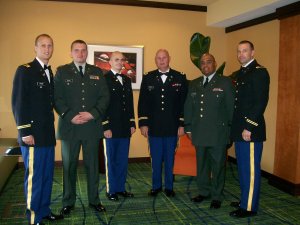
me and some of my buddies
.
July 11, 2009
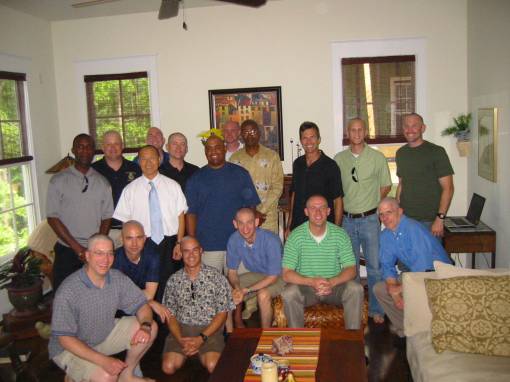
New Friends
The differences between being a “civilian” and being in the military are pretty, well…HUGE. 🙂 There are good things with that and bad things. I figured I would spell some of those out for you now…mainly by showing the differences between being an Officer vs. Enlisted and an Army Chaplain and a Pastor.
Before I start though, here are some basic differences to think about between being in the Army and being a civilian: to drive to work you have to show several armed guards your Military ID card, make sure they saw your military sticker on the windshield, drive through some barricades and drive ON the speed limit or under while on the post (Military Police or MPs have no mercy…one mile an hour over is easily justification for a ticket), you wear the same clothes everyday (well, you have at least 4 sets of the same clothes), your used to seeing people walk around with weapons…big weapons, you salute to people higher in rank than you and return salutes to people lower in rank than you, every Army guy or gal knows the mission statement of the post and your all fighting for the same thing on purpose, every morning starts around 6am for morning excercises with all of your closest friends for the next hour, most lunch breaks start at 1130 and end at 1300 (1pm)…which leads me to my next point, everyone operates on military time and you learn not to try to get anything done on post during the lunch period because everyone shuts down…even if your waiting in line to get your blood checked, everyone knows that they will likely be deployed in the next two years and spend a year away from their families…
Now, the differences between being an Officer (Chaplains are officers) and Enlisted: The enlisted men and women make up the backbone of the Army…right now there’s about 420,000 enlisted Soldiers and almost 70,000 Officers (less than 2,000 of them are Chaplains).
– An Army Officer is responsible for leading violence during a war (coming up with the plans and making the big decisions, stepping on the field first and stepping off last) while the enlisted men and women are responsible for carrying it out under the leadership of the Officer.
-Every Officer has a Bachelors degree, some Enlisted men and women do, but its not required (unless you want help getting promoted).
-The lowest ranked Officer is higher in rank than the highest ranked Enlisted man or women…its a humbling thing to be walking around and have one of the highest ranked Enlisted men (almost 50 years old) on the post walk up to you and say “Good afternoon, Sir” and salute you…
-In a normal week I initiate a salute to a higher ranking officer once or twice a week and I return a salute from a lower ranking Officer or Enlisted man or woman at least a couple times a day…you don’t salute indoors, unless your reporting to a senior ranked person…generally just out doors walking to your car or something.
That’s good for now…the differences between a Chaplain (CH) and a civilian Pastor:
-A CHs congregation is huge…a lower ranking CH is responsible for a Battalion (about 600-1,000 Soldiers)
-A CH risks his life for the spiritual care of his Soldiers: Since 1775 24,000 CHs have served in the US Army. During WW2 the Chaplaincy Corps had the 3rd highest percentage of deaths among all of the Army Corps…the highest was Aviators, and 2nd highest was the infantry. Overall, the CH Corps has had a low kill rate…
-A CH takes an Oath from God, affirmed by the President of the United States and Congress to serve
-Has the responsibility of being an Officer: A responsibility of modeling what it means to be a gentleman, holding high regard and respect for all people and always staying on your “A” game.
-Holds a very high physical, intellectual and moral standard:
Physically: When was the last time you saw your Pastor or thought your Pastor could handle running several miles in the morning followed up by push-ups and sit-ups and then head to work…enough said.
Intellectual:Every Army Chaplain has to have a Masters degree in theology that is 72 credit hours or higher and is encouraged to pursue more education…in fact many seminaries will give you 1/3 of the credit hours needed for a Doctorate of Ministry degree just for finishing up your basic Army Chaplaincy training…usuallyafter you have been in for several years the Army will pay you to go and get more education…
Moral:You mess up in the Army over moral integrity and your careers down the drain…doesn’t matter what you do or how high your rank is…one of the highest ranking Officers in the United States Navy drove up to the base gate intoxicated and he was out of the Navy…if you have an affair in the Army then they’ll say “see ya.”
Well, there’s some of my biased opinions…please let me know what things you would like to learn more about…be it the Army or Chaplaincy Corps, my training or whatever else…I could use some help coming up with more article topics!
Shalom out…
 Baptized